Agricultural tanks & hoppers
Develop tanks and hoppers around equipment frames. Identify the actual medium and temperature rather than assuming universal chemical resistance. Mounting, seasonal delivery and weathering need project-specific acceptance criteria.
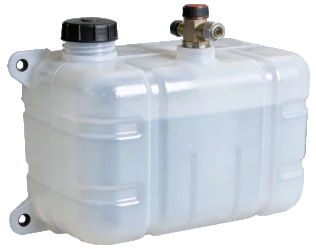
What to send for a useful review
- Medium, concentration and contact duration
- Continuous, peak and minimum temperature
- UV exposure, climate and colour stability
- Insert material, torque and pull-out load
- Static load, impact, vibration and mounting
Catalogue examples show applications, not guaranteed specifications. Grade, dimensions, testing and delivery are agreed for each project.
Discuss your projectContinue exploring
LLDPE, HDPE and resin selection
LLDPE and HDPE are common rotomolding resin families, but the family name is not a complete specification. Select a supplier grade using stiffness, impact, environmental stress cracking, processability and operating exposure. Ask for the current data sheet and identify the test conditions behind each value. Do not substitute an injection or extrusion grade solely because it shares the same polymer name. For repeated OEM orders, agree how material or pigment substitutions are approved and recorded.
Read guide ↗Reading density and melt-index data
Density and melt index help compare candidate resins, but neither replaces finished-part testing. Compare melt-index values only at the same temperature and test load. Check stiffness and impact together rather than choosing the stiffest grade automatically. A datasheet value belongs to its stated specimen and method; it is not a direct promise for a large molded tank or cover. Record grade, pigment, processing history and measurement conditions during sampling so later changes can be evaluated meaningfully.
Read guide ↗Why wall thickness varies
Wall distribution depends on heat, mold geometry, material movement and loading arrangement. Start with an inspection map and process records rather than accepting total weight as proof of uniformity. Investigate whether thin areas align with shielding, deep features or changes in powder movement. Trial one controlled adjustment at a time and verify the other surfaces have not become unacceptable. A uniform-looking exterior does not reveal the condition of the inside wall.
Read guide ↗